
Central heating not working
If the radiators are cold but the hot water still works, the usual suspects are a failed diverter valve, a seized pump, or the programmer set to water only.
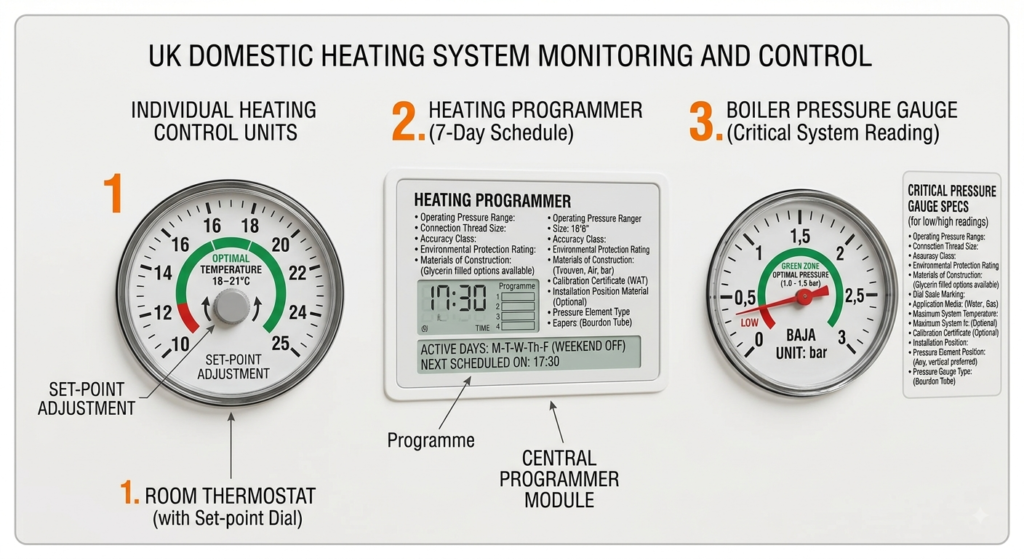
Before calling anyone, check three things: the thermostat, the programmer schedule, and the boiler pressure gauge. Those account for a large share of callouts and take two minutes to rule out.
Quick checks before you call anyone
None of these involve opening anything. Work through them in order:
- Thermostat — set above current room temperature. Batteries if it's wireless
- Programmer — on the right schedule, and the clock correct after a time change
- Boiler pressure — the gauge should read between 1 and 1.5 bar when cold
- Fault code — anything displayed on the boiler, write it down before resetting
- Other radiators — is it every radiator, or just some?
That last one splits the problem in two. If most radiators are warm and one or two are cold, the boiler is fine and it's a radiator issue.
Central heating not working but hot water is
This combination is diagnostic. Hot water works but radiators stay cold, which means the boiler is firing — the heat just isn't reaching the heating circuit.
| Cause | What's happening | Who fixes it |
|---|---|---|
| Programmer set to water only | Schedule wrong, nothing is broken | You |
| Diverter valve failed | Boiler sends heat to the cylinder, not the radiators | Gas Safe engineer |
| Motorised valve stuck | The valve to the heating circuit isn't opening | Heating engineer |
| Pump seized | Hot water is direct, heating needs circulation | Heating engineer |
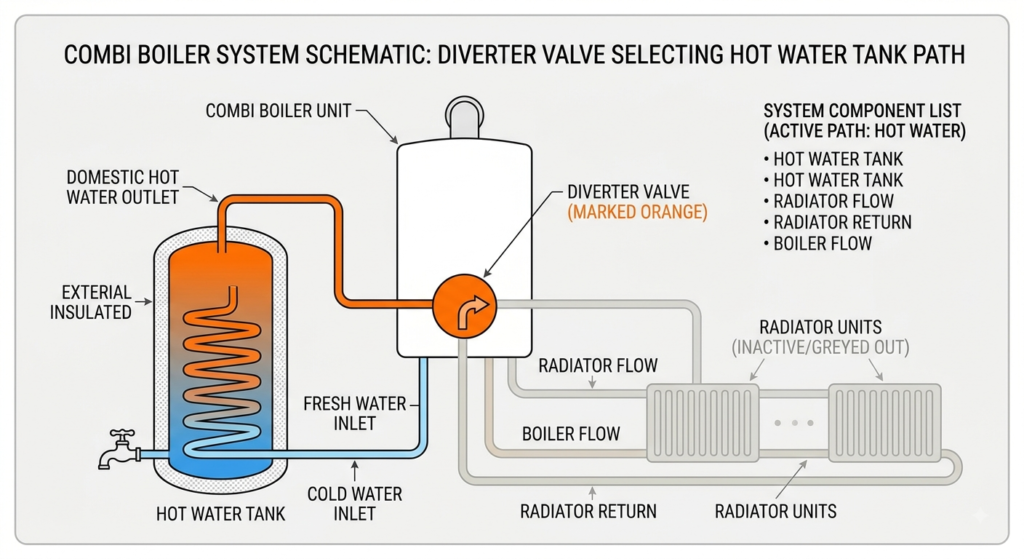
The diverter valve is the most common failure on a combi boiler, and the symptom is exactly this. It's a routine repair, but it's inside a gas appliance — that's Gas Safe territory.
Boiler pressure
Most modern boilers lock out below about 1 bar and refuse to fire. The gauge is on the front, usually a small dial with a green band.
Low pressure means the system has lost water somewhere. Topping it up gets the heating running again, but it doesn't fix why it dropped — and if you're refilling it every few weeks, there's a leak.
Above 2.5 bar is the opposite problem: overfilled, or a failed expansion vessel. Either way the pressure relief valve will start discharging.
Repressurising is done with the filling loop, and the procedure varies enough between boilers that the manual is the right source. If yours has been topped up more than twice this year, get the system looked at rather than topped up again.
Thermostat and programmer problems
The most common cause of "the heating has broken" is the heating being told not to come on.
Batteries are the classic. Wireless thermostats give little warning — the display looks normal until it stops transmitting.
Lost pairing. Wireless thermostats occasionally lose their link to the receiver by the boiler. Most have a re-pair procedure in the manual, and it usually takes a minute.
Smart thermostats — Hive, Nest, Tado — add a layer of things that can go wrong. Check the app shows the system online, that a schedule is actually running, and that nobody has left it in holiday or frost-protection mode.
Clock drift after a time change catches people out every spring and autumn. The schedule is fine, the clock isn't.
Pump problems
The circulating pump moves hot water round the radiator circuit. If it stops, the boiler heats water that goes nowhere.
The symptoms are fairly distinctive: hot water still works, the boiler sounds like it's running, and the flow pipe leaving the boiler is hot while the radiators stay cold. Sometimes there's a low humming with no circulation, which is a pump trying to start against a seized rotor.
Pumps seize most often after a summer of standing idle. That's why heating problems cluster in the first cold week of autumn.
A seized pump is sometimes freed and sometimes replaced. Either way it's a heating engineer — the pump sits within the pressurised system and swapping it means draining part of it.
Oil-fired central heating
Off-grid systems fail differently. Three things account for most of it:
The tank is empty. Obvious, and more common than you'd think — sight gauges stick, and remote monitors go flat.
Sludge or water in the fuel. Condensation builds up in the tank over years and eventually reaches the outlet. The burner locks out.
Frozen fuel line. Kerosene waxes in a hard frost, particularly on exposed external pipework.
Oil boilers aren't Gas Safe territory — the equivalent scheme is OFTEC. Same principle applies: reset it once if it's locked out, and if it locks out again, call someone.
When to call an engineer
Call someone if:
- The boiler shows a fault code and locks out again after one reset
- Pressure keeps dropping and needs regular topping up
- Hot water works and the heating doesn't, and the programmer is set correctly
- There's a smell, an unusual noise, or visible water around the boiler
- Nothing on the quick checks above changed anything
Two things that are never DIY, regardless of how straightforward a video makes them look: anything inside a gas boiler, and anything involving the gas supply. In the UK that work is restricted by law to Gas Safe registered engineers, and you can check any engineer's registration on the Gas Safe Register site.
Typical repair costs
| Job | Typical UK cost |
| Engineer call-out and diagnostic | £70 – £120 |
| Replace thermostat | £100 – £250 |
| Replace motorised valve | £150 – £300 |
| Replace pump | £250 – £400 |
| Replace diverter valve | £250 – £400 |
| Emergency or out-of-hours call-out | £150 – £300 |
Most diagnostic visits are charged whether or not anything is wrong, so it's worth running the quick checks first. A flat thermostat battery is an expensive thing to pay a call-out for.
Prices checked August 2026
More radiator problems
If the problem turns out to be one radiator rather than the whole system, these are the next step.
Frequently asked questions
Why is my central heating not working but the hot water is?
The boiler is firing, so the heat isn't reaching the radiator circuit. Usually a failed diverter valve, a stuck motorised valve, or a seized pump. Check the programmer isn't set to water only first.
Why is my central heating not working?
Start with the thermostat, the programmer schedule and the boiler pressure. Those three cover a large share of failures and cost nothing to check.
Can I fix central heating myself?
You can check thermostats, programmers and pressure, and bleed radiators. You cannot work on a gas boiler — that's restricted by law to Gas Safe registered engineers.
What pressure should my boiler be at?
Between 1 and 1.5 bar when the system is cold. Below 1 bar most boilers lock out. Above 2.5 bar suggests overfilling or a failed expansion vessel.
How do I reset my boiler?
Most have a reset button or a dial position marked R. Reset once. If it locks out again, stop and call an engineer — repeated resets on a faulting boiler are not a fix.
Is it worth repairing an old boiler?
Roughly: if the repair costs more than a third of a replacement and the boiler is over twelve years old, replacement usually works out better.