
Radiator leaking water: causes and how to fix it
Most radiator leaks come from one of three places: the valve, the pipe joint underneath, or the radiator body itself.
Put a container under the drip, then find the exact source before you touch anything. A leak at a valve or joint can usually be tightened. A leak from the body means the metal has corroded through, and no amount of tightening will fix it.
Where is your radiator leaking from?
The location tells you almost everything. Dry the radiator completely, wait ten minutes, and see where the water reappears.
| Leak location | Likely cause | Fixable yourself? | What to do |
| At the valve | Loose union nut or worn packing | Usually | Tighten a quarter turn |
| Pipe joint below | Loose compression fitting | Sometimes | Tighten a quarter turn |
| Radiator body | Internal corrosion, pinhole | No | Replace the radiator |
| Bleed valve | Worn bleed plug | Yes | Replace the plug |
| Blanking plug | Failed seal | Sometimes | Re-seal with PTFE tape |
| Only when heating is on | Expansion at a weak joint | Sometimes | Tighten, then monitor |
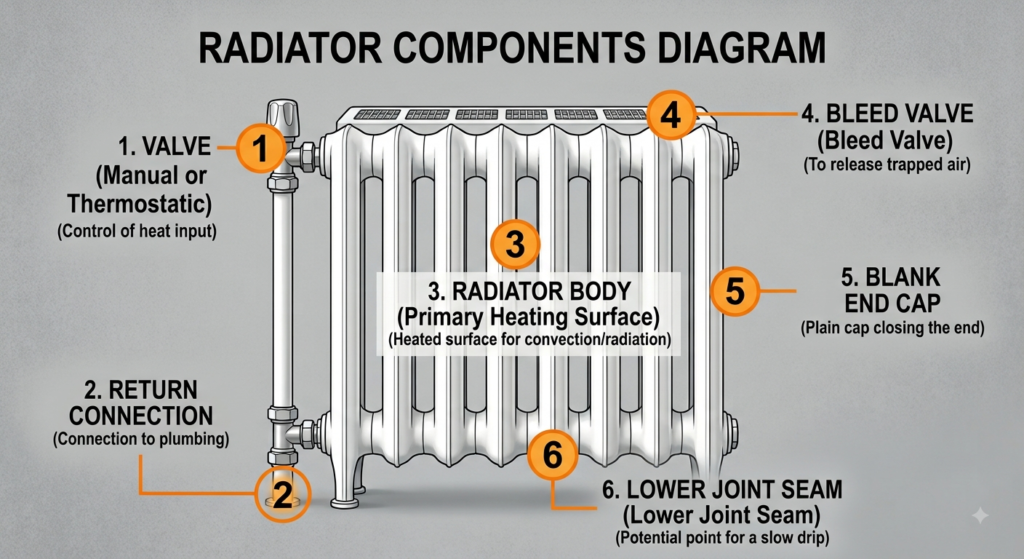
Radiator leaking from the bottom
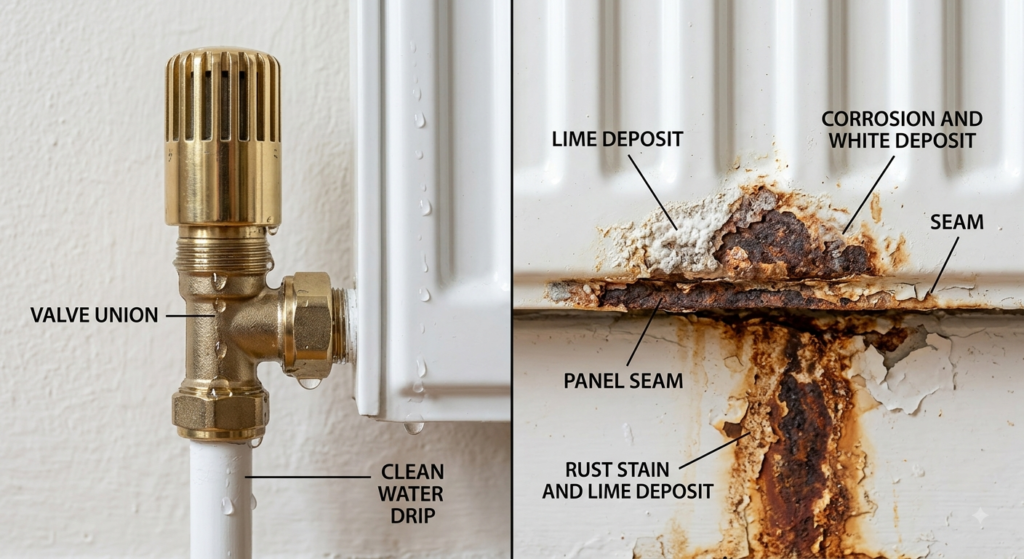
Two very different problems look identical from a metre away.
Leaking at the joint — water appears where the pipe meets the valve, or where the valve meets the radiator. The radiator itself is fine. Tighten the union nut a quarter turn with an adjustable spanner, no more, and see if it stops.
Leaking from the body — water seeps from the bottom edge of the panel itself, often with rust staining or a chalky white deposit around it. That's internal corrosion, and it means the steel has thinned from the inside until it perforated. There's no repair. The radiator needs replacing.
The test: dry everything, then run a finger along the bottom seam of the panel. If the water is coming from the seam rather than a fitting, it's the body.
Radiator leaking from the top
Leaks at the top corner are almost always the bleed valve. The small square or slotted plug wears over time, especially if it's been opened and closed a lot.
If it drips only after bleeding, it wasn't closed tightly enough. Close it a little further — gently, the thread is soft brass and strips easily.
If it drips constantly, the plug or its washer has failed. A replacement bleed plug costs a couple of pounds and takes minutes to fit, but the system needs isolating first: close both valves at the bottom of the radiator before you unscrew anything.
The other candidate is the blanking plug at the opposite top corner. Same fix, wrapped in fresh PTFE tape. If you end up replacing the radiator, check the output you actually need before ordering — the old one may have been undersized all along.
How to find a radiator leak
Slow leaks are hard to place because the water travels before it drips. By the time you see it, it's already moved.
The paper towel method finds it in ten minutes:
- Dry the entire radiator, valves and pipework with a cloth
- Wrap dry paper towel around each valve, the pipe joints and along the bottom seam
- Turn the heating on and leave it half an hour
- Check which towel is wet — that's your source
If several are damp, start with the highest one. Water runs down.
How to stop a radiator leak
What you can do depends on where it is, but the first steps are the same for all of them:
- Container and towels under the leak
- Turn the heating off and let the radiator cool
- Find the exact source with the paper towel method above
- If it's a fitting, tighten a quarter turn — no more
- If it keeps leaking, close both valves to isolate the radiator
- Note how many turns you closed the lockshield valve, you'll need that to rebalance later
A quarter turn is the whole instruction. Overtightening a compression fitting crushes the olive and turns a drip into a proper leak.
Does radiator leak sealant work?
Sometimes, and only for a specific problem: a pinhole leak in the radiator body that you can't get to.
Sealant is added to the system water and circulates until it finds the gap. It can buy months, occasionally longer. What it can't do is fix a loose fitting — that's mechanical, and sealant won't tighten anything.
The cost: sealant thickens the system water slightly and can clog the boiler's heat exchanger or a magnetic filter over time. Most heating engineers treat it as a way to get through winter, not a repair.
If the radiator is leaking from the body, budget for a replacement rather than a bottle.
Is a leaking radiator dangerous?
Not in the way most people worry about. A central heating radiator contains water, not gas. It cannot leak gas, and it cannot explode.
The real risks are ordinary but expensive:
- Water damage — a slow drip through a floor does more harm over weeks than a burst does in an hour
- Electrics — water reaching a socket or a light fitting below. If that's happening, kill the power at the consumer unit first
- Falling pressure — a leak drops system pressure, and below about 1 bar most boilers lock out
If you can smell gas, that's a completely separate problem and nothing to do with the radiator. Leave the property and call the National Gas Emergency Service on 0800 111 999.
What does it cost to fix?
Typical UK prices for the most common jobs:
| Job | Typical cost |
| Tighten a leaking valve | £60 – £100 |
| Replace one radiator valve | £90 – £150 |
| Replace both valves | £140 – £220 |
| Replace the radiator | £180 – £400 |
| Emergency call-out | £150 – £300 |
Full breakdown of radiator repair costs
More radiator problems
A leak is often not the only thing going wrong. These guides cover the symptoms that tend to come with it.
Frequently asked questions
Why is my radiator leaking water?
Usually a loose fitting at a valve or pipe joint, or internal corrosion in the radiator body. The location tells you which — fittings can be tightened, corrosion can't.
Why do radiators leak?
Fittings work loose through years of expansion and contraction. Radiators corrode from the inside when the system water lacks inhibitor, and eventually perforate.
What do I do if my radiator is leaking?
Container underneath, heating off, find the exact source, then tighten a quarter turn if it's a fitting. If it keeps leaking, close both valves to isolate the radiator and call a plumber.
Is a leaking radiator dangerous?
Not directly. It contains water, not gas. The risks are water damage, contact with electrics, and losing system pressure.
Can a radiator leak gas?
No. A wet central heating radiator has no gas in it. If you can smell gas, leave the property and call 0800 111 999.
Does radiator leak sealant work?
For a pinhole in the radiator body, sometimes. For a loose fitting, no — that needs tightening, not sealing.
If the radiator is cold as well as leaking, there may be more than one thing going on — trapped air and sludge cause their own set of symptoms.