
Radiator BTU chart and size guide
A standard 600 × 1000mm radiator puts out about 3,345 BTU as a Type 11, or 5,911 BTU as a Type 22. Same wall space, nearly double the heat.
All the figures on this page are at ΔT50, taken from Stelrad's published output tables. If you're comparing against another manufacturer, check they're quoting at the same ΔT.
Radiator output by size and type
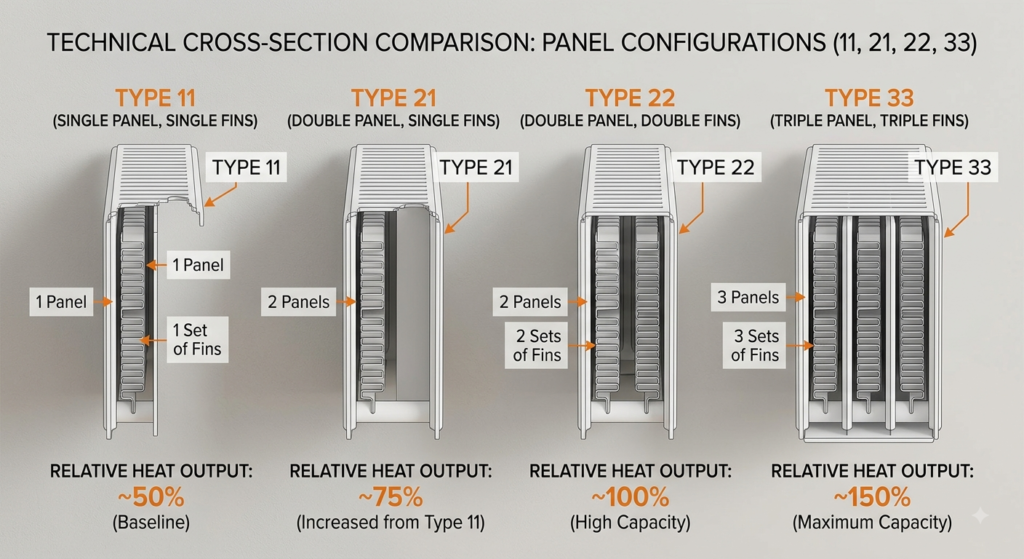
Output in BTU per hour at ΔT50, from Stelrad Compact published data. Type 11 is a single panel, Type 21 a double panel with one convector, Type 22 a double panel with two.
| Size (H × W mm) | Type 11 | Type 21 | Type 22 |
| 300 × 1000 | 1,737 | 2,543 | 3,352 |
| 450 × 1000 | 2,580 | 3,601 | 4,679 |
| 600 × 600 | 2,007 | 2,754 | 3,546 |
| 600 × 1000 | 3,345 | 4,590 | 5,911 |
| 600 × 1400 | 4,683 | 6,427 | 8,277 |
| 600 × 1800 | 6,021 | 8,263 | 10,642 |
| 700 × 1000 | 3,812 | 5,222 | 6,693 |
Standard UK radiator sizes
UK radiators come in a predictable set of dimensions. Heights of 300, 450, 600 and 700mm cover almost everything horizontal, with lengths in 100 or 200mm steps.
| Height | Available lengths | Typical use |
| 300mm | 400 – 1800mm | Low sills, bay windows |
| 450mm | 400 – 1800mm | Restricted wall height |
| 600mm | 400 – 2000mm | The UK standard |
| 700mm | 400 – 1600mm | Larger rooms |
| 1400 – 2000mm | 300 – 600mm | Vertical radiators |
Depth varies by type: around 60mm for a Type 11, 100mm for a Type 22. Worth checking before you order if the radiator sits in a corridor or behind a door.
BTU needed by room type
Base rates before adjustment, in BTU per cubic metre. Multiply by room volume, then adjust for glazing, external walls and insulation.
| Room | BTU per m³ | Example: 4×4×2.4m |
| Living room | 137 | 5,260 |
| Dining room | 137 | 5,260 |
| Bedroom | 120 | 4,608 |
| Home office | 120 | 4,608 |
| Hallway | 120 | 4,608 |
| Kitchen | 102 | 3,917 |
| Bathroom | 154 | 5,914 |
| Conservatory | 216 | 8,294 |
Run the full calculation for your room
How to measure a radiator
If you're replacing rather than specifying from scratch, four measurements matter:
- Height — top of the panel to the bottom, not including brackets or feet
- Width — panel only, not including the valves
- Depth — front face to wall
- Pipe centres — the distance between the two valve inlets
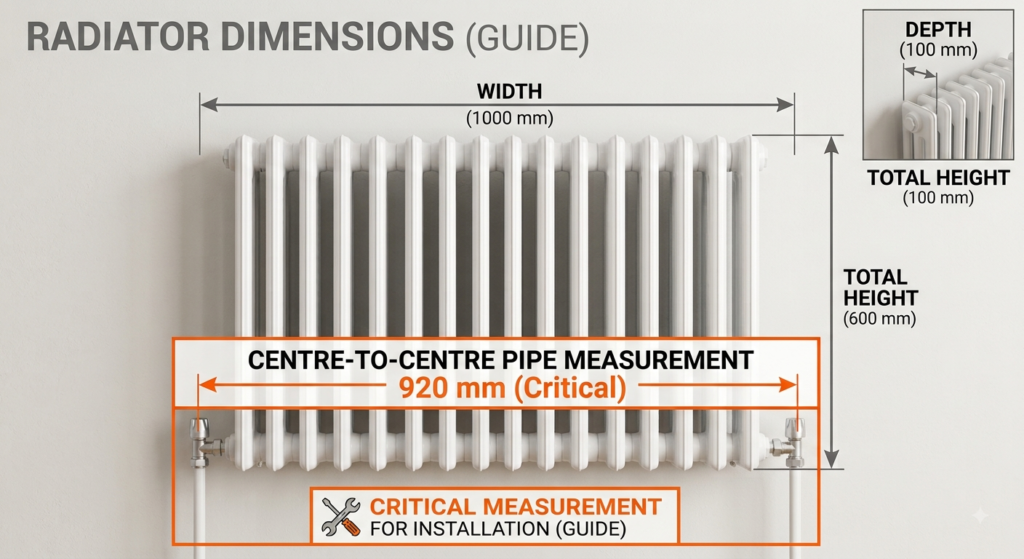
That last one is the important one. Match the pipe centres and you can swap the radiator without touching the pipework. Get it wrong and you're paying a plumber to move pipes, which costs considerably more than the radiator.
Understanding ΔT
Every output figure on this page assumes ΔT50, which is the UK testing standard under BS EN 442: 75°C flow, 65°C return, 20°C room.
Run your system cooler and the radiator gives less. That matters more than it used to, because condensing boilers and heat pumps both work better at lower flow temperatures.
| ΔT | Multiply ΔT50 output by | Typical system |
| 60 | 1.268 | Old, pre-2014 ratings |
| 50 | 1.000 | Standard boiler |
| 45 | 0.871 | Boiler, weather compensated |
| 40 | 0.747 | Low temperature boiler |
| 35 | 0.627 | High temp heat pump |
| 30 | 0.513 | Typical heat pump |
| 25 | 0.404 | Efficient heat pump |
| 20 | 0.302 | Underfloor territory |
So that 600 × 1000mm Type 22 rated at 5,911 BTU delivers 3,032 BTU on a heat pump at ΔT30. Same radiator, half the heat.Which is why radiators sized in watts rather than BTU are easier to compare across manufacturers.
Other heatrooms calculators
These tables tell you what a radiator gives out. The calculators below work out what your room needs.Frequently asked questions
How many BTU is a standard radiator?
A 600 × 1000mm Type 22 — the most common size in UK homes — gives about 5,911 BTU at ΔT50. The same size in Type 11 gives 3,345.
What size radiator do I need for a 4m x 4m room?
Around 5,300 BTU as a living room before adjustments, or closer to 6,000 with a safety margin. A 600 × 1000mm Type 22 covers it.
What's the difference between single and double panel?
A Type 11 has one panel and one set of convector fins. A Type 22 has two of each, and gives roughly 1.8 times the output for the same wall space.
How do I measure a radiator for replacement?
Height, width, depth and pipe centres. Pipe centres are the one that determines whether you can swap without moving pipework.
What does ΔT50 mean?
It's the standard test condition: 75°C flow, 65°C return, 20°C room temperature. All UK manufacturers publish output at ΔT50 under BS EN 442.
Are BTU ratings accurate for heat pumps?
Not directly. A heat pump runs cooler, so multiply the ΔT50 figure by around 0.513 to get the real output at ΔT30.
(ENLACE INTERNO a /radiator-types/ en la tercera FAQ.)