
Radiator types explained
UK radiators fall into three families: panel radiators (the standard white ones, classified as Type 11, 21 or 22), column radiators (the traditional cast-iron look), and vertical or designer models.
Type 22 is the most common in modern homes, because it gives the most heat for the wall space it occupies.
Panel radiator types: 11, 21 and 22
The numbering isn't arbitrary. The first digit is the number of panels, the second is the number of convector fin sets welded behind them.
| Type | Panels | Fin sets | Also called | Relative output |
|---|---|---|---|---|
| Type 11 | 1 | 1 | Single panel single convector, K1 | 1.0× |
| Type 21 | 2 | 1 | Double panel single convector, P+ | 1.37× |
| Type 22 | 2 | 2 | Double panel double convector, K2 | 1.77× |
| Type 33 | 3 | 3 | Triple panel triple convector, K3 | ~2.4× |
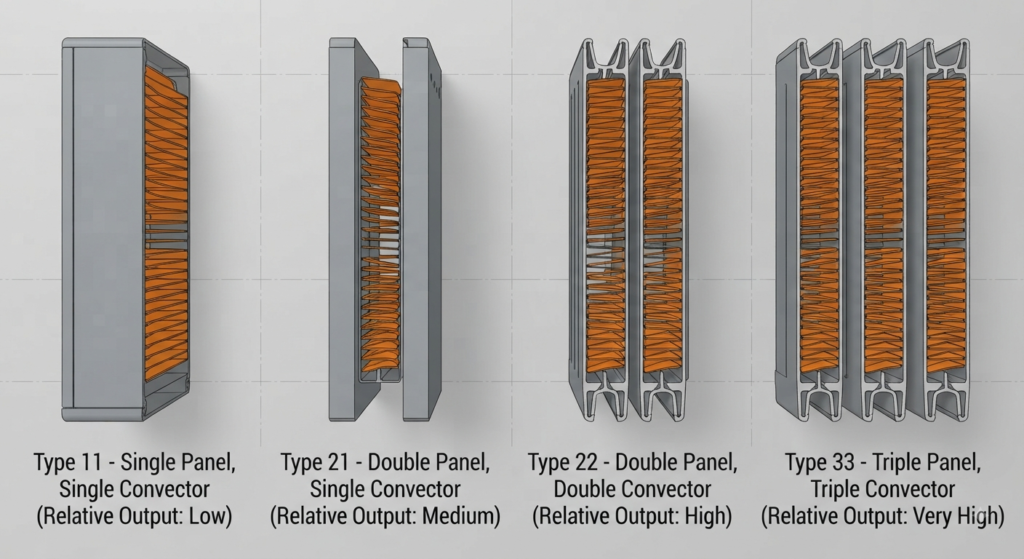
Same height, same width, very different output. A 600 × 1000mm Type 11 gives 3,345 BTU. The identical footprint in Type 22 gives 5,911.
The trade-off is depth. A Type 11 sticks out around 60mm from the wall, a Type 22 around 100mm.
Column radiators
The traditional look — vertical tubes in rows, originally cast iron, now mostly steel.
They hold considerably more water than a panel radiator and have a large surface area, which makes them slow to warm up and slow to cool down. In a room that's heated all day that's an advantage. In one heated for two hours a night it isn't.
That thermal mass and surface area also makes them one of the better options for a heat pump, which runs at lower flow temperatures and needs more radiator surface to deliver the same heat.
They cost more than panels — often two or three times as much for equivalent output — and weigh enough that wall fixings matter. Cast iron in particular usually needs floor-mounting.
Vertical radiators
Tall and narrow rather than wide and low. They exist to solve a space problem: a wall with no room for a conventional radiator, or a room with high ceilings and limited wall length.
The honest trade-off: you get less heat per pound spent. A vertical radiator giving the same output as a standard horizontal panel typically costs considerably more, and there are fewer sizes to choose from.
There's also a placement issue. Convection means hot air rises, so a tall radiator delivers a good deal of its heat to the ceiling. In a room with 3-metre ceilings that's a real loss.
Where they earn their place: narrow hallways, kitchens where every wall is units, bathrooms, and rooms where a radiator would otherwise sit under a floor-length window.
Towel, designer and electric radiators
Towel radiators
Ladder-style rails for bathrooms. Output is low for their size — a typical towel rail gives 1,500 to 2,500 BTU, which won't heat a large bathroom on its own. Many are fitted alongside underfloor heating or a small panel radiator for that reason.
Designer radiators
A category defined by appearance rather than engineering. Flat panels, mirrored fronts, unusual shapes. The heat output is often lower than a conventional radiator of the same size, and the price considerably higher. Worth it if the radiator is a focal point, not if it's behind a sofa.
Electric radiators
No connection to the heating circuit — they heat oil or a thermal fluid electrically. Running costs are high compared with gas, so they make sense for spaces the central heating doesn't reach: garages, conservatories, extensions and loft conversions.
Which radiator type should you choose?
| Situation | Best type | Why |
| Standard room, best value | Type 22 panel | Most heat per pound and per centimetre of wall |
| Low sill or under a window | Type 21 or 22, 300–450mm high | Fits without blocking the glass |
| Narrow wall, no width available | Vertical | Height instead of width |
| Heat pump system | Column, or oversized Type 22 | More surface area at lower flow temperature |
| Bathroom | Towel rail plus a panel | Towel rails alone rarely give enough |
| Period property | Column | Matches the building |
| Garage, conservatory, extension | Electric | No pipework to run |
| Radiator on show | Designer | Accept lower output for appearance |
Whichever type you pick, the output figure comes first. Use the calculator to work out the output you need before choosing a style.
Radiator types and heat pumps
This is where the choice matters most, and it's a question that barely existed five years ago.
A gas boiler sends water out at around 75°C. A heat pump sends it at around 45°C. That drops a radiator from ΔT50 to roughly ΔT30, and at ΔT30 a radiator delivers about half its rated output.
The consequence: most homes moving to a heat pump need radiators around twice the size, or the same size in a much higher output type.
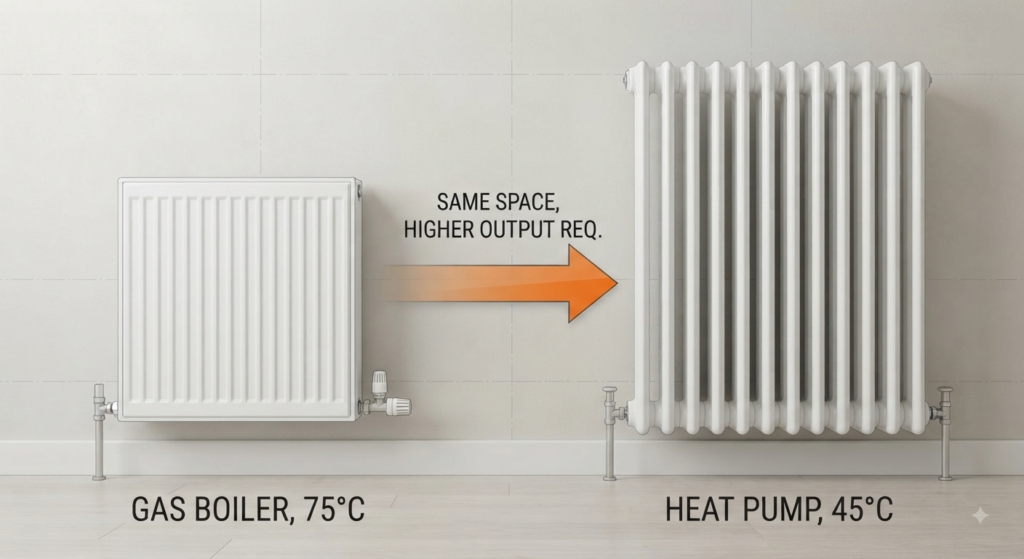
In practice that means going from Type 11 to Type 22, or from Type 22 to Type 33 or a column radiator. Sometimes the existing radiators are already generous enough — an oversized system on a boiler becomes a correctly sized one on a heat pump.
If a heat pump is anywhere in your plans, size for it now. Replacing radiators twice costs considerably more than buying bigger ones once.
More radiator guides
Choosing a type is one decision. These cover the rest — how they actually work, and what it costs to move one.
Frequently asked questions
What is the difference between Type 11, 21 and 22 radiators?
The first digit is the number of panels, the second the number of convector fin sets. A Type 22 has two of each and gives roughly 1.8 times the output of a Type 11 the same size.
Which radiator type gives the most heat?
For a given size, Type 33 — three panels, three fin sets. Among common types, Type 22 gives the most heat for the wall space it takes up.
Are vertical radiators less efficient?
Not less efficient, but less heat per pound and per square metre of wall. They're a space solution, not a performance one.
What radiator type is best for a heat pump?
Column radiators or oversized Type 22 panels. Heat pumps run cooler, so you need more surface area to deliver the same heat.
Can I replace a Type 11 with a Type 22?
Usually yes, if the pipe centres match and there's room for the extra depth — a Type 22 sits about 40mm further from the wall. The output jump is worth it.
What are column radiators made of?
Modern ones are steel. Traditional and reproduction models are cast iron, which holds far more water and usually needs floor-mounting rather than wall brackets.