
Radiator not heating up
Feel the radiator. Cold at the top and warm at the bottom means trapped air — bleed it and it's fixed in five minutes. Cold at the bottom and warm at the top means sludge, which needs flushing.
If it's cold all over while the others are hot, the valve is stuck. If every radiator in the house is cold, the problem is the boiler, pump or pressure rather than the radiator.
Diagnose it by where it's cold
Run your hand from the top of the panel to the bottom. Where the temperature changes tells you what's wrong:
| Where it's cold | Cause | Fix | DIY? |
|---|---|---|---|
| Top, warm at bottom | Trapped air | Bleed the radiator | Yes |
| Bottom, warm at top | Sludge build-up | Power flush | Engineer |
| Cold all over, others hot | Stuck valve | Free the TRV pin | Yes |
| Warm but never hot | Needs balancing | Adjust the lockshield | Careful |
| Cold only in far rooms | System imbalance | Balance the system | Careful |
| Every radiator cold | Boiler, pump or pressure | Different problem | → boiler |
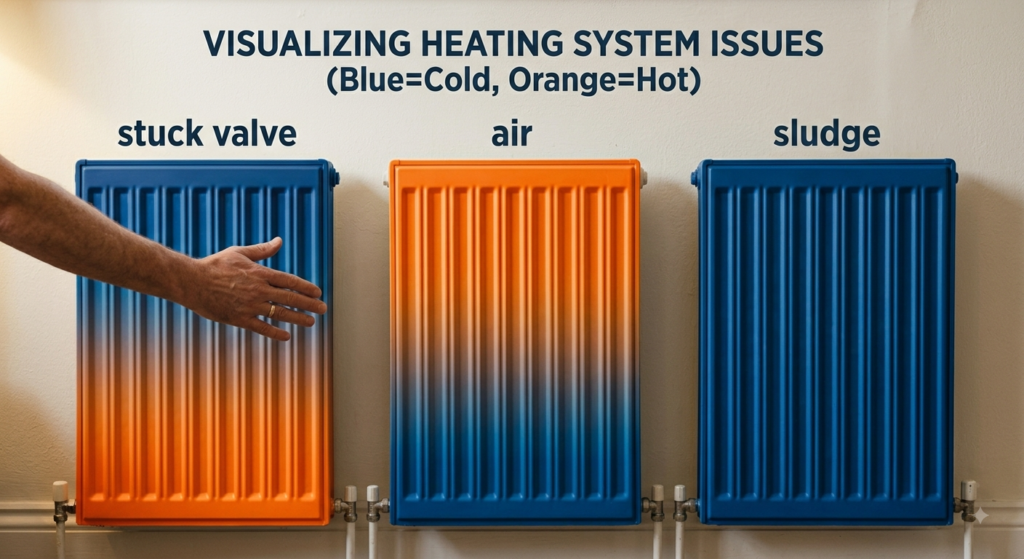
Cold at the top: trapped air
Air rises to the highest point of the radiator and sits there, blocking hot water from filling the top of the panel. It's the most common radiator fault and the easiest to fix.
Where the air comes from: fresh water introduced when the system is topped up, and hydrogen generated by corrosion inside the system. The second kind comes back. If you're bleeding the same radiator every few weeks, corrosion is the real problem.
The fix takes minutes — heating off, bleed key, quarter turn, close it as soon as water appears. And then check the boiler pressure, because bleeding drops it.
Cold at the bottom: sludge
Black iron oxide sludge settles at the bottom of the panel, where the water moves slowest. Enough of it and the lower half of the radiator stops circulating.
The confirmation: bleed the radiator and see what comes out. Clear water is normal. Black water means the system is full of magnetite, and this radiator isn't the only one affected.
Bleeding won't help here — the problem is a solid, not a gas. The options are a power flush, a chemical flush for milder cases, or removing that one radiator and flushing it outside with a hose.
A magnetic filter fitted afterwards catches the particles before they settle again. Most engineers fit one as standard now, and it's the difference between flushing once and flushing every five years.
Cold all over: a stuck valve
If one radiator is stone cold while the rest of the house is warm, the thermostatic valve has probably seized. The pin underneath the head sticks in the closed position, usually after a summer of not moving.
How to check it:
- Turn the heating off and let things cool
- Unscrew the TRV head — it turns off by hand, no tools
- Look at the metal pin underneath. It should sit proud and spring back when pressed
- If it's stuck down, free it with gentle taps from a pair of pliers or a light tap with a spanner handle
- Work it up and down a few times, then refit the head
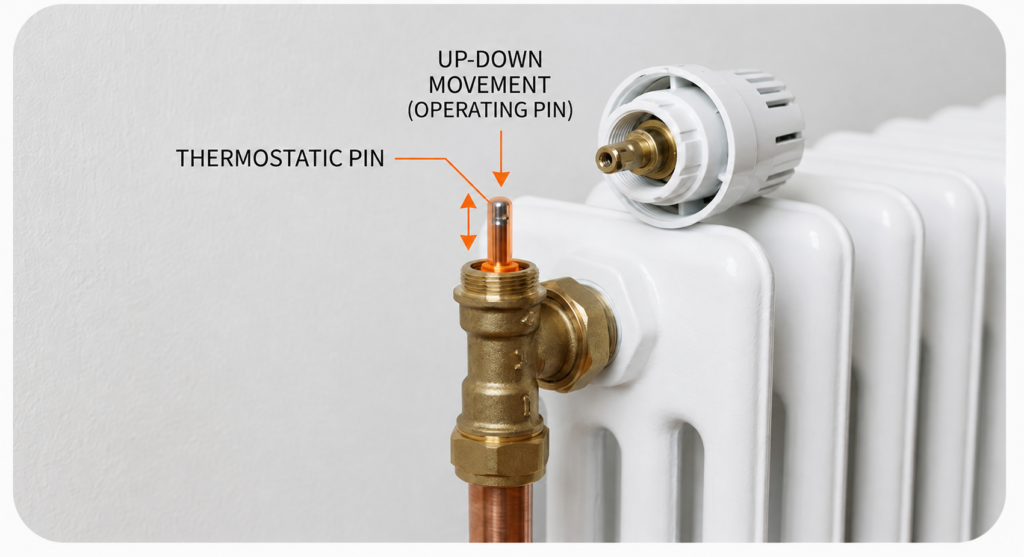
It's the most satisfying fix on this page and it costs nothing. If the pin won't move at all, the valve body has failed and needs replacing.
Worth doing every autumn as prevention: open all TRVs fully for a day before the heating season starts.
Radiator still cold after bleeding
You bled it, water came out, and it's still cold. That rules out air, which narrows things considerably.
No air came out at all — the problem was never air. Look at the valve or at sludge instead.
Air came out but it's still cold at the bottom — sludge. Bleeding removes gas from the top, not solids from the bottom.
It was fine for a day and then went cold again — air is being generated by corrosion, not left over from filling. That's a system problem, not a radiator problem.
Everything went cold after bleeding — check the boiler pressure. Bleeding releases water as well as air, and if pressure dropped below 1 bar the boiler will have locked out.
Warm but never properly hot
A radiator that reaches lukewarm and stops isn't blocked — it's getting less flow than the others. Water takes the path of least resistance, so radiators nearest the boiler steal it from the ones further away.
Balancing fixes it. The lockshield valve — the one with the plastic cap rather than the numbered head — throttles flow to each radiator so they all warm at the same rate.
The rough method: close the lockshield on the radiators nearest the boiler by a turn or two, which pushes more flow to the far ones. Open the cold ones fully.
Do it in small increments and note every change. Getting it wrong makes a different radiator cold, and without notes you can't get back to where you started.
Specific situations
A new radiator that won't heat up
Almost always air, and usually a lot of it — fitting a radiator introduces a system's worth. Bleed it, top up the pressure, and bleed it again the following day. Also check both valves are actually open: they're often left closed after fitting and forgotten.
A towel radiator that stays cold
Towel rails sit high in the system and collect air more than anything else. They also have small bleed points that clog. If bleeding doesn't work, check the valves — towel rails are frequently plumbed with the flow and return the wrong way round.
One radiator cold upstairs, rest fine
Air, in almost every case. The highest radiator in the system collects it first. If it recurs monthly, the system is generating hydrogen through corrosion and needs inhibitor.
When to call an engineer
- Black water comes out when you bleed
- Several radiators are cold at the bottom
- The same radiator needs bleeding every few weeks
- The TRV pin won't move at all
- Every radiator is cold, not just one
- Balancing has made things worse rather than better
The first three all point the same way: the system water is contaminated, and no amount of bleeding fixes that. A flush plus inhibitor plus a magnetic filter is the actual repair.
More radiator problems
A cold radiator has a handful of causes. These guides cover the fixes for each one.
Frequently asked questions
Why is one radiator not heating up when the others are?
Either a stuck thermostatic valve or the radiator needs balancing. Check the TRV pin first — it takes two minutes and costs nothing.
Why is my radiator cold at the top but hot at the bottom?
Trapped air. Bleed it, then check the boiler pressure afterwards because bleeding lowers it.
Why is my radiator cold at the bottom but hot at the top?
Sludge settled in the base of the panel. Bleeding won't help — it needs flushing.
Why is my radiator still cold after bleeding?
If no air came out, it was never air. Look at the valve, or at sludge if it's cold at the bottom. If it went cold again after a day, corrosion is generating hydrogen in the system.
Should I bleed a radiator hot or cold?
Cold, with the heating off. A hot system is pressurised and will spray water rather than release air.
Do I need a power flush?
Only if the system water is dirty — black water when bleeding, several radiators cold at the bottom. One radiator with trapped air doesn't need one.