
How to bleed a radiator
Turn the heating off and let the radiators cool. Hold a cloth under the bleed valve at the top corner, turn the key anticlockwise a quarter turn, and wait for the hissing to stop. Close it the moment water appears.
Then check the boiler pressure. Bleeding releases water as well as air, and if the gauge drops below 1 bar the boiler will lock out.
Should the heating be on or off?
Off, and cold. Both matter, for different reasons.
With the heating running, the system is pressurised. Open a bleed valve and you get hot water under pressure rather than air — messy at best, a scald at worst.
And when the pump is running, air is circulating with the water rather than sitting at the top of the panel where you can release it. Switch off and give it twenty minutes for the air to collect where you need it.
The one exception: to find out which radiators need bleeding, run the heating first and feel each one. Cold at the top means air. Then turn everything off, wait, and bleed those.
What you'll need
- A radiator bleed key — a couple of pounds from any hardware shop
- A cloth or small container to catch the drips
- An old towel for the floor
- A flat-head screwdriver as an alternative on slotted bleed valves
That's it. No tools beyond this, and nothing needs draining or isolating.If you end up replacing a radiator instead, check the output you need first.
Step by step
- Turn the heating off and wait until the radiators are cold to the touch, around 20 minutes
- Find the bleed valve — top corner of the radiator, a small square or slotted plug
- Position your cloth underneath and hold it there
- Turn the key anticlockwise, a quarter turn only. You'll hear hissing as air escapes
- Wait for the hissing to stop. It can take 20 or 30 seconds on a badly airlocked radiator
- Close it as soon as water appears — turn clockwise until snug, no tighter
- Repeat on any other cold radiators, working ground floor first
- Check the boiler pressure and top up if it's below 1 bar
- Turn the heating back on and check the radiators warm evenly
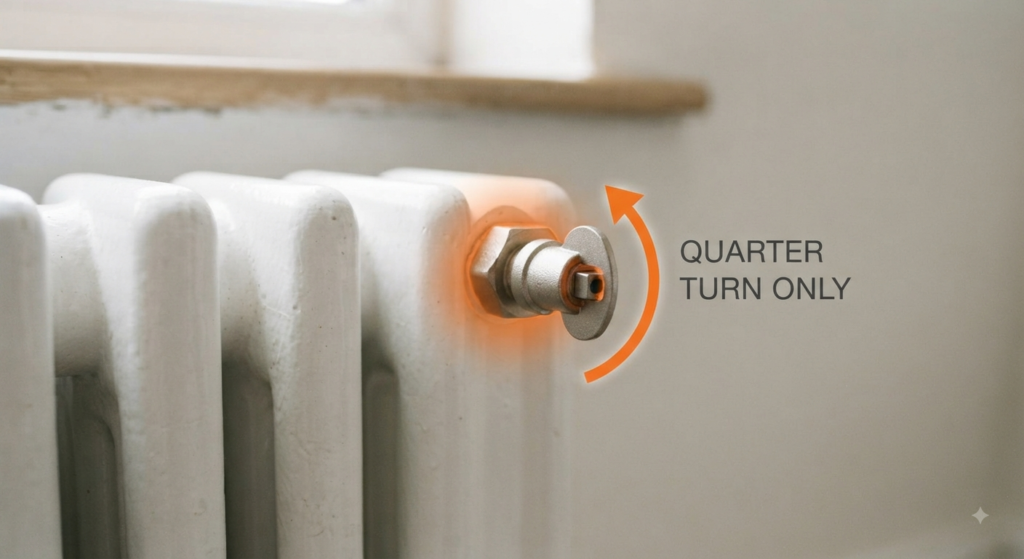
How to bleed a radiator without a key
Depends on the valve. Look at the bleed point closely:
A slot across it — a flat-head screwdriver works perfectly. Many modern radiators are made this way deliberately.
A square peg — this is what the key is for. A small adjustable spanner or a pair of pliers can grip it, but the brass is soft and rounds off easily. Once it's rounded, the key won't work either and you've made things worse.
Recessed square with no access — key only.
Honestly, a bleed key costs about two pounds and every hardware shop has them. Pliers on a square valve is a false economy that ends with a plumber removing a rounded plug.
What order should you bleed radiators in?
Ground floor first, then upstairs. Within each floor, start with the radiator furthest from the boiler and work back towards it.
The logic: air rises and collects at the highest points. Bleeding downstairs first pushes remaining air upwards, where you release it last. Do it the other way round and you'll be bleeding the upstairs radiators twice.
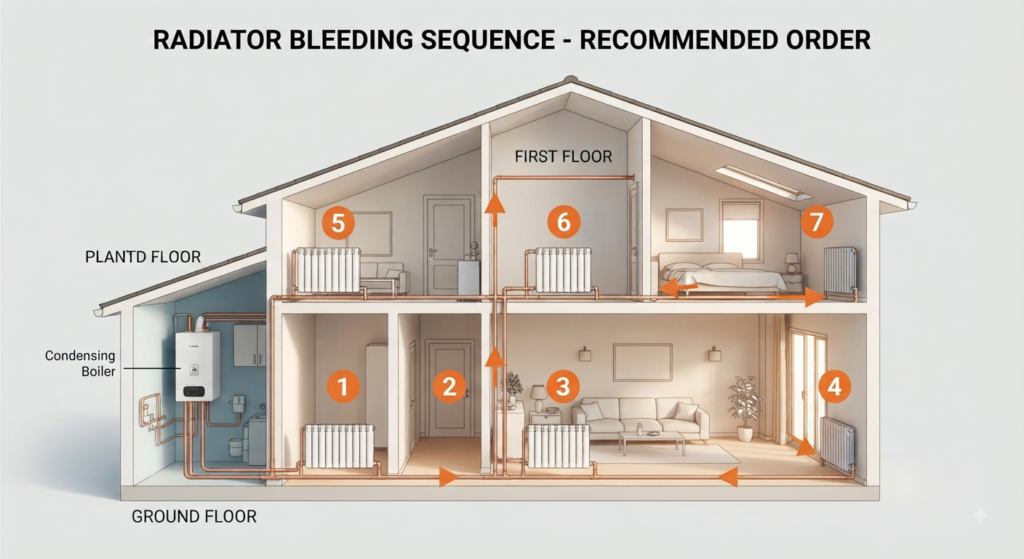
If you're bleeding the whole house, check the boiler pressure halfway through as well as at the end. Ten radiators can drop the pressure enough to lock the boiler out before you've finished.
When should you bleed a radiator?
The signs are consistent:
- Cold at the top, warm at the bottom — the classic
- Gurgling or bubbling when the heating runs
- Slow to warm up compared to the other radiators
- After any work on the system, or after topping up the pressure
As routine maintenance, once a year before the heating season is plenty.
If a radiator needs bleeding every few weeks, that's not maintenance — that's corrosion generating hydrogen inside the system, and it needs inhibitor rather than another bleed.
Bleeding with a combi boiler
Same procedure, one extra step that matters more.
A combi is a sealed system — no header tank in the loft to refill it automatically. Every bit of water you release when bleeding lowers the pressure permanently until you top it up yourself.
Bleed three or four radiators and the gauge can easily drop from 1.3 to below 1 bar, at which point the boiler locks out and the heating stops. People then assume they've broken something.
Topping up is done with the filling loop, a braided hose under the boiler with a valve at each end. Open both slowly, watch the gauge, and close them at 1.2 to 1.5 bar. The procedure varies enough by model that the manual is the right source.
Still cold after bleeding?
If no air came out, air was never the problem. Two likely culprits: a seized thermostatic valve, or sludge sitting in the bottom of the panel.
The distinction is simple. Cold all over while the others are hot points to the valve. Cold at the bottom with a warm top points to sludge, and no amount of bleeding shifts a solid.Both are covered in the guide to radiators that won't heat up.
More radiator problems
Bleeding fixes trapped air and nothing else. If it didn't work, the cause is somewhere in here.
Frequently asked questions
Should I bleed radiators with the heating on or off?
Off, and cold. A hot system is pressurised and will spray water instead of releasing air. Give it twenty minutes to cool so the air collects at the top.
Can you bleed a radiator without a key?
If the bleed valve has a slot, a flat-head screwdriver works. If it's a square peg, use the key — pliers round off the soft brass and then nothing fits.
In what order should I bleed my radiators?
Ground floor first, then upstairs. Within each floor, furthest from the boiler first.
How often should I bleed my radiators?
Once a year before the heating season. If one needs it every few weeks, the system is generating hydrogen through corrosion and needs inhibitor.
Why is my radiator still cold after bleeding?
If no air came out, it wasn't air. A stuck valve makes a radiator cold all over. Sludge makes it cold at the bottom only.
Do I need to top up the pressure after bleeding?
Check it. Bleeding releases water as well as air, and on a combi there's no header tank to refill it. Below 1 bar the boiler locks out.