
Cost of moving a radiator
Moving a radiator in the UK costs £150 to £300 if it stays on the same wall, and £250 to £500 if it moves to a different wall.
The price is driven by one thing: how far the pipework has to travel, and what has to come up to get it there.
Prices checked August 2026
Cost of moving a radiator
| Job | Typical cost | Time |
| Move along the same wall, under 1m | £150 – £250 | 2 – 3 hours |
| Move to an adjacent wall | £250 – £400 | 3 – 5 hours |
| Move to the opposite side of the room | £300 – £550 | 4 – 6 hours |
| Move to a different room | £400 – £700 | Full day |
| Add a new radiator on the same circuit | £300 – £600 | Half day |
| Fitting a new radiator at the same time | +£80 – £300 | — |
| Lifting a solid floor for pipework | +£150 – £400 | — |
Two jobs get confused. Removing a radiator to decorate is free and takes twenty minutes — close both valves and lift it off. Moving it means new pipework, and that's what costs.
What affects the price
- Distance — every extra metre is more pipe, more time, and often more floor lifted
- Floor type — floorboards lift and go back down. Concrete has to be chased or the pipe run around the skirting
- Whether the system needs draining — usually yes for anything beyond a short move
- Access — fitted units, tiled floors and boxed-in pipework all add hours
- Location — London and the South East run 20–30% above the national average
- Making good afterwards — filling, plastering and redecorating are often quoted separately
The floor is the variable that moves the price most. The same one-metre move can be £150 upstairs on floorboards and £450 downstairs on a concrete slab.
Moving a radiator to another wall
The cost hinges on the pipe route. There are three, and the plumber will pick whichever your house allows:
Under the floor — the tidiest and usually the cheapest on a suspended timber floor. Boards come up, pipe runs across, boards go back.
Around the skirting — used when the floor is solid. Cheaper than chasing concrete but the pipe is visible unless it's boxed in.
Through the ceiling below — sometimes the only option on a solid ground floor. It means damage to the ceiling underneath and making good afterwards.
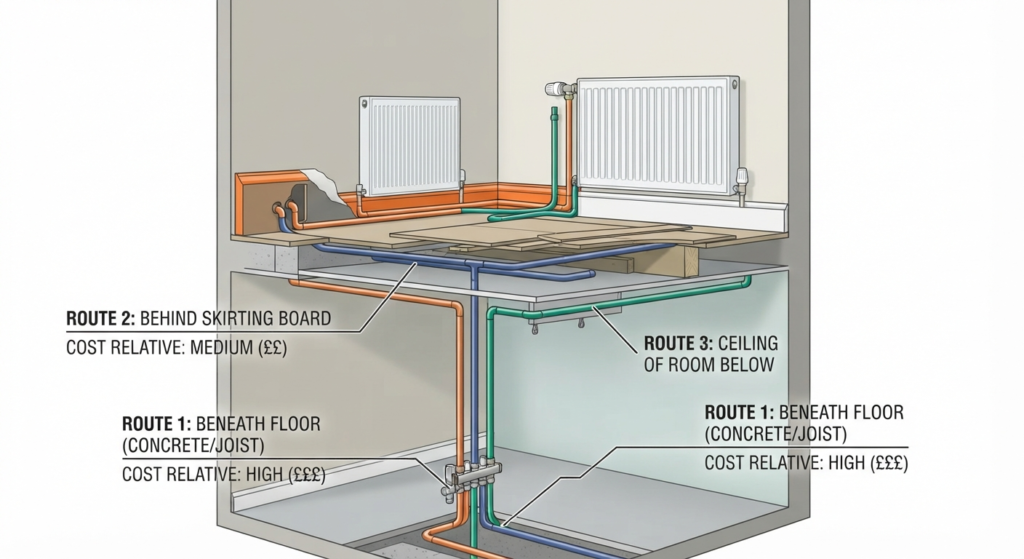
Worth asking which route is being quoted for. Two quotes that differ by £200 often differ because one includes lifting a floor and the other runs pipe along the skirting.
Can you move a radiator yourself?
Possible with plumbing experience, not a good first project.
The steps are: isolate and drain that section, cut and cap the old pipework, run new pipe to the new position, fit and connect the radiator, refill, bleed, rebalance and re-pressurise the boiler.
Two things catch people out. Joints that hold at low pressure can weep once the system is hot and pressurised, and you often won't know until hours later. And draining is easy, refilling without airlocks is not — an air-locked circuit can take a long time to clear.
What you can safely do yourself: remove a radiator temporarily to decorate. Close both valves, note how many turns you closed the lockshield, and reverse it when you put it back.
Do you need to move it at all?
Sometimes the answer is no, and the alternatives are cheaper.
Fit a vertical radiator in the same place. Same pipework, a third of the wall width. Solves most "the radiator is in the way of the sofa" problems for the price of a radiator.
Fit a higher output type instead. A Type 22 gives nearly twice the heat of a Type 11 the same size, so you can go shorter without losing output. Same position, same pipes.
Move the furniture. Worth saying out loud. A radiator behind a sofa loses some of its output, but not enough to justify £400 of pipework in every case.
The one case where moving is genuinely the answer: the radiator is on the wrong wall for the room to work, and no change of radiator fixes that.
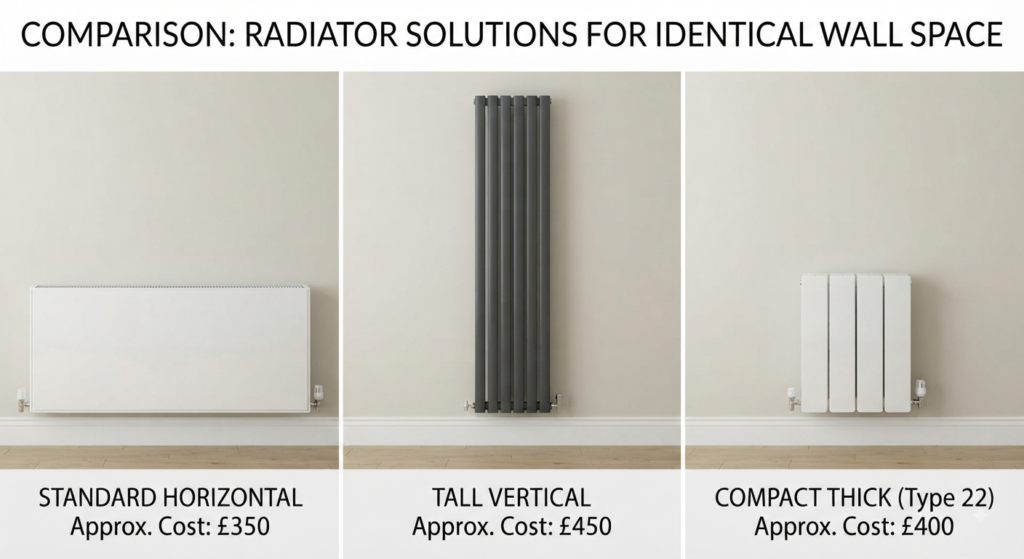
Will moving it affect how well the room heats?
Slightly, and it depends where it ends up.
Radiators traditionally sit under windows for a reason: the cold air falling off the glass meets the rising warm air and mixes, instead of pooling across the floor. With single glazing that effect was significant. With modern double glazing it's much smaller.
Move a radiator to an internal wall and you may notice a cooler zone near the window. Usually minor, occasionally enough to want slightly more output.
The other consideration is balancing. A radiator moved further from the boiler sits differently in the circuit, and the system may need rebalancing afterwards. Worth asking whether that's included in the quote.
More radiator guides
Before moving one, it's worth knowing whether a different radiator would solve the same problem.
Frequently asked questions
How much does it cost to move a radiator?
£150 to £300 on the same wall, £250 to £500 to a different wall. A solid floor pushes it higher because the pipe route is harder.
How long does it take to move a radiator?
Two to three hours for a short move on a timber floor. A full day if it's going to another room or the floor is solid.
Can I move a radiator myself?
With plumbing experience, yes. It means draining, cutting and rejoining pipework, then refilling and rebalancing. Removing a radiator to decorate is a different, much simpler job.
Do I need to drain the system to move a radiator?
Usually yes, or at least that section of it. That's a large part of why it costs more than it looks like it should.
Is it cheaper to move a radiator or fit a new one?
Fitting a different radiator in the same position is almost always cheaper, because the pipework doesn't change. A vertical or higher-output model often solves the same problem.
Does moving a radiator away from the window matter?
A little. The under-window position counteracts cold air falling off the glass. With modern double glazing the effect is small, but you may notice a cooler patch near the window.