
How does a radiator work?
A radiator circulates hot water from your boiler through a metal panel. The panel heats the air touching it, that warm air rises, cooler air is drawn in underneath, and the room warms through a slow circulating current.
Which means the name is wrong. Most of the heat a radiator delivers is convection, not radiation — typically 70 to 80% of it.
The heating circuit, step by step
From boiler to room and back, the loop looks like this:
- The boiler heats water to around 70°C
- The pump pushes it out through the flow pipe
- Water enters the radiator through the inlet valve, usually a TRV
- Heat transfers from water to steel, and from steel to the air touching it
- Cooled water leaves through the lockshield valve at the other end
- It returns to the boiler through the return pipe to be reheated
- The cycle continues while the thermostat is calling for heat
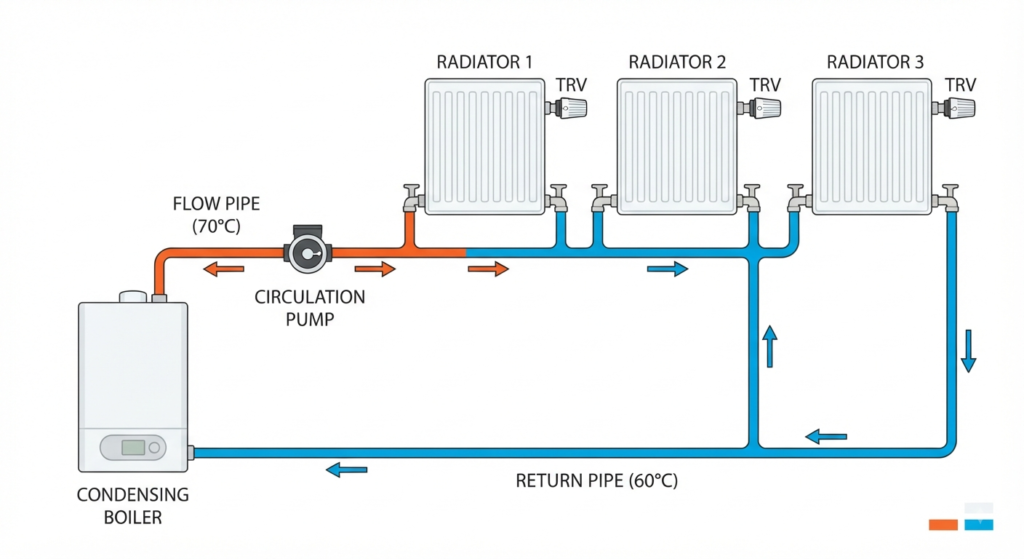
Water leaves a radiator around 10°C cooler than it went in. That difference is the heat that ended up in your room.
Radiation or convection?
Both happen, in very different proportions:
| Mechanism | Share of output | How it works |
|---|---|---|
| Convection | 70 – 80% | Air heated at the surface rises, cooler air replaces it, a current forms |
| Radiation | 20 – 30% | Infrared emitted directly to objects and people in the room |
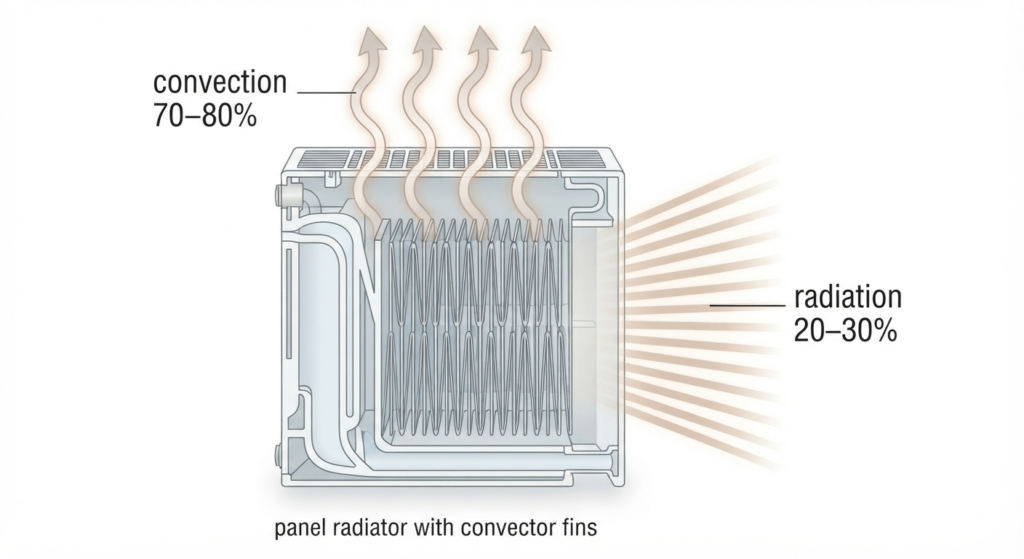
This is why convector fins exist. Those corrugated metal strips welded to the back of a Type 21 or 22 add no radiating surface facing the room at all — they exist purely to multiply the surface area in contact with air.
It's also why a radiator with a shelf directly above it heats the room worse, and why blocking the gap underneath with a thick rug does more harm than covering the front. It also means a radiator needs sizing on output rather than surface area.
What each valve does
Thermostatic radiator valve (TRV)
The numbered head at one end. Inside is a wax or liquid capsule that expands as the room warms, pushing a pin down to close the valve. It's controlling the room, not the radiator — which is why a TRV behind a curtain reads the wrong temperature and shuts off too early.
Lockshield valve
The one with the plain plastic cap at the other end. It's set once during balancing to control how much flow this radiator gets relative to the others, then left alone. Adjusting it randomly is how one room ends up cold.
Bleed valve
The small square or slotted plug at the top corner. Air rises to the highest point of the panel and blocks circulation there. The bleed valve lets it out.
Why radiators go under windows
It looks like the worst possible spot — putting heat next to the coldest surface in the room. It was actually deliberate.
Cold air in contact with glass gets denser and falls, sliding across the floor as a draught. A radiator directly underneath sends warm air up through that falling cold air, and the two mix before either reaches you.
The convention dates from single glazing, when that downdraught was strong enough to make a room uncomfortable regardless of the air temperature. Modern double glazing has a much warmer inner surface, so the effect is far weaker — which is why new-build rooms often have radiators on internal walls with no ill effect.
In a period property with single glazing, the old logic still holds.
Why one radiator gets hot and another doesn't
Water takes the path of least resistance. Left to itself, most of it goes through the radiators nearest the boiler and comparatively little reaches the far end of the circuit.
That's what balancing corrects. The lockshield valves on the near radiators are partly closed, adding resistance, which forces more flow to the ones further away. Done properly, every radiator warms at roughly the same rate.
An unbalanced system usually shows itself the same way: downstairs radiators near the boiler are hot within minutes, the far bedroom takes an hour and never quite gets there.
How electric radiators differ
No boiler, no pump, no circuit. An electric radiator heats a sealed reservoir of oil or thermal fluid with an internal element, and that fluid warms the panel.
The physics of how the heat reaches the room is identical — mostly convection, some radiation. What changes is the running cost. Electricity costs roughly three to four times as much per unit as gas, so an electric radiator makes sense where there's no wet system to connect to rather than as a replacement for one.
More radiator guides
Once the mechanism makes sense, the practical questions are easier — which type to fit, and where to put it.
Frequently asked questions
How does a radiator heat a room?
Hot water from the boiler warms the metal panel, the panel warms the air touching it, and that air rises and circulates. Around 70 to 80% of the heat is delivered by convection rather than radiation.
Do radiators actually radiate heat?
Only about a fifth to a third of their output. The rest is convection, which is why convector fins are welded to the back of most modern panels.
What temperature is the water in a radiator?
Around 70°C on a gas boiler system, leaving roughly 10°C cooler than it entered. A heat pump runs much lower, typically around 45°C.
Why is my radiator hot at the top and cold at the bottom?
Sludge settled in the base of the panel, blocking circulation there. Trapped air causes the opposite pattern — cold at the top, warm at the bottom.
Does turning a radiator off save money?
In an unused room, yes. But closing too many pushes more flow through the rest and can make the boiler cycle inefficiently. Turning one down is usually better than turning it off.
How long does a radiator take to heat a room?
Fifteen to thirty minutes for the radiator itself, longer for the room. Column radiators hold more water and take longer, but stay warm longer after the heating stops.